Selecting Bone Screws for medical device procurement requires more than comparing unit prices. These small implants support fixation, stability, and recovery. Their dimensions, thread design, material grade, and surface finish can influence surgical handling and clinical performance. Procurement teams should examine each detail.
Reliable decisions begin with documented evidence. Review supplier qualifications, manufacturing controls, inspection records, and product traceability. Confirm that specifications match the intended surgical application. Material certificates, dimensional reports, packaging details, and sterilization information deserve careful attention. Independent testing can add confidence when risks or product changes appear significant.
Supplier experience also matters. A capable manufacturer should explain tolerances clearly and respond to technical questions without vague promises. Audits, sample evaluations, and controlled trial orders can reveal practical issues. Packaging should protect threads and prevent contamination during transport. Storage conditions need equal attention.
No procurement decision is flawless. Some teams may focus too heavily on price. That approach can overlook inspection costs, supply interruptions, or inconsistent batches. A lower quotation is not always better value. Clinical users should participate in the evaluation, because surgeons and operating-room staff notice handling problems that documents may miss.
For dependable sourcing, build a balanced review process. Compare performance, evidence, service capacity, and long-term supply reliability. Maintain clear records for every approved model and supplier. Reassess them when materials, designs, or manufacturing sites change. This disciplined approach helps organizations choose Bone Screws with greater confidence, while recognizing that quality depends on both the product and the procurement system behind it.
Bone screws are small fixation devices with a demanding job. They stabilize fractures, anchor plates, secure spinal constructs, and hold grafts in position. Their threads grip cortical or cancellous bone, depending on the design. Some screws compress a fracture. Others lock into a plate and preserve alignment.
The World Health Organization’s 2022 musculoskeletal health report estimates that 1.71 billion people live with musculoskeletal conditions worldwide. This figure shows the scale of orthopedic care, but it does not guarantee uniform screw demand. Clinical protocols, trauma rates, and hospital budgets still differ sharply. Procurement teams should review diameter, thread profile, head design, material, sterility, and imaging compatibility. FDA device records and applicable standards can support traceability and quality checks. A useful screw is not simply the strongest one. It must match bone quality, surgical technique, and expected loading.
Tips: Ask for fatigue data, torque specifications, corrosion testing, sterilization validation, and lot-level documentation. Check whether the instruments fit the implant system. This detail is often missed. It can delay a procedure. Also, avoid judging suppliers only by unit price; inconsistent packaging or poor traceability may create larger costs. Some assumptions will remain imperfect, so surgeons and biomedical engineers should review procurement criteria together.
Bone screws are small, but their role in surgery is substantial. They secure bone fragments, plates, grafts, and fixation systems during healing. Their value depends on the procedure, anatomy, and patient needs. In fracture repair, screws can compress separated bone edges and support stable alignment. In spinal procedures, they may anchor constructs while vertebrae recover. Hand, foot, dental, and reconstructive surgeries also require carefully selected fixation. One design cannot suit every case.
Surgeons consider diameter, length, thread pattern, head shape, and material. A screw placed near a joint needs precise measurement. A longer screw is not automatically stronger. It may irritate soft tissue or reach an unsafe structure. Imaging, sterile handling, and calibrated instruments support reliable placement. Procurement teams should review documentation, traceability, packaging integrity, and system compatibility. Clinical feedback matters too. A technically excellent product can still fail operationally if staff find it difficult to use.
Tips: Match screw dimensions to the intended anatomy and procedure. Confirm sterilization status before opening each package. Keep multiple sizes available for unexpected bone quality. Ask surgeons and operating-room staff about insertion feel. Their experience reveals practical issues that specifications may miss. Reassess purchasing decisions using complication reports and usage data. Perfection is unlikely. Careful review reduces avoidable surprises.
Bone screws combine material science with fixation mechanics. Titanium alloy, especially Ti-6Al-4V, offers high strength, corrosion resistance, and relatively low weight. It also produces less imaging interference than stainless steel. Stainless steel remains practical for selected applications, supported by established standards such as ISO 5832-1. ASTM F136 covers titanium alloy requirements for surgical implants.
Bioabsorbable screws use polymers such as PLLA, PGA, or blended materials. They may reduce long-term implant removal procedures, but degradation can affect strength and local tissue response. Magnesium alloys are gaining research attention because they gradually resorb. Their clinical evidence remains less mature. The data is not perfect. A procurement decision should examine fatigue testing, sterilization effects, and actual clinical follow-up.
Design changes performance. Cortical screws use finer threads, while cancellous screws use deeper threads for softer bone. Locking screws connect with a plate and improve angular stability. Cannulated designs support guidewire placement, and self-tapping tips can shorten surgical steps. Variable-pitch threads may improve compression across a fracture site. According to Grand View Research’s 2024 orthopedic implants report, the global market was valued at approximately USD 44 billion in 2023, reflecting strong demand for implant systems. Yet market growth does not prove every design is suitable. Procurement teams should compare pull-out strength, insertion torque, dimensional accuracy, and failure data. Small details matter. A cheaper screw may create higher costs through difficult insertion, loosening, or revision procedures.
| Material | Typical Material Characteristics | Common Clinical Uses | Imaging Considerations | Procurement Considerations |
|---|---|---|---|---|
| Titanium alloy Commonly Ti-6Al-4V |
High strength-to-weight ratio, good corrosion resistance, relatively low elastic modulus compared with stainless steel, and generally favorable biocompatibility. | Fracture fixation, spinal fixation, maxillofacial surgery, and small-fragment orthopedic systems. | Produces less magnetic susceptibility than stainless steel and is widely compatible with MRI protocols, subject to the specific device’s labeling. | Verify material certification, surface treatment, dimensional tolerances, fatigue performance, and MRI safety documentation. |
| Stainless steel Commonly corrosion-resistant surgical grades |
High strength, hardness, and wear resistance; typically more rigid and heavier than titanium alloys. | Trauma fixation, temporary fixation, cortical screws, and applications requiring high rigidity. | Can create more imaging artifact than titanium and requires confirmation of MRI conditions before clinical use. | Assess corrosion resistance, galvanic compatibility with other implants, sterilization compatibility, and applicable regulatory documentation. |
| Cobalt-chromium alloy | Very high strength, stiffness, wear resistance, and corrosion resistance; higher elastic modulus than titanium. | Selected high-load fixation systems and specialized orthopedic applications where rigidity is important. | May cause substantial imaging artifact; MRI conditions must be evaluated according to device labeling. | Confirm alloy composition, fatigue strength, manufacturing consistency, and compatibility with instruments and adjacent components. |
| Bioabsorbable polymer Examples include PLLA, PGA, and PLGA-based materials |
Designed to gradually degrade through hydrolysis; avoids permanent metallic hardware but generally has lower initial strength. | Selected soft-tissue fixation, small-fragment fixation, osteochondral procedures, and situations where later implant removal may be undesirable. | Usually produces minimal metal-related artifact; degradation can create time-dependent radiographic changes. | Review degradation profile, inflammatory response data, storage conditions, shelf life, and strength retention over the intended healing period. |
| PEEK Polyether ether ketone |
Radiolucent, chemically stable, and lower in stiffness than metals; often used where imaging visibility is valuable. | Selected spinal and specialized fixation applications; use depends on the required load and design validation. | Generally produces little radiographic artifact, allowing improved visualization of surrounding bone. | Confirm radiolucency requirements, mechanical testing, sterilization method, radiographic markers, and applicable biocompatibility evidence. |
| Design Feature | Design Options | Functional Purpose | Suitable Use Considerations | Key Evaluation Criteria |
|---|---|---|---|---|
| Thread profile | Coarse, fine, or variable pitch | Controls purchase, resistance to pull-out, and advancement through bone. | Coarse threads are often used in softer bone; fine threads can be useful where higher thread engagement is needed. | Thread depth, pitch accuracy, pull-out strength, insertion torque, and compatibility with the target bone quality. |
| Shaft configuration | Fully threaded, partially threaded, or variable-threaded | Affects compression, fixation stability, and the ability to capture or lag bone fragments. | Partially threaded designs may provide interfragmentary compression when the geometry and technique are appropriate. | Compression performance, thread transition, bending strength, and availability of required lengths. |
| Tip design | Blunt, self-tapping, or drill-point tip | Influences drilling requirements, insertion efficiency, and risk of damage to surrounding tissue. | Self-tapping tips can reduce procedural steps when validated for the intended bone and technique. | Tip sharpness, cutting performance, insertion torque, debris generation, and instrument compatibility. |
| Head configuration | Hexagonal, star-shaped, slotted, low-profile, or countersunk | Provides driver engagement and determines prominence, torque transfer, and soft-tissue clearance. | Low-profile or countersunk heads may be preferred where implant prominence is a concern. | Driver fit, stripping resistance, torque capacity, head strength, and availability of matching instruments. |
| Locking capability | Standard screw, locking screw, or variable-angle locking screw | Allows direct bone purchase or fixed-angle attachment to a plate or fixation construct. | Locking designs can support angular stability, particularly in comminuted or osteoporotic fracture constructs. | Locking interface strength, allowable angulation, torque limits, plate compatibility, and validated instrumentation. |
| Fenestration or cannulation | Solid, cannulated, or fenestrated | Supports guidewire placement and, in selected systems, delivery of bone graft or injectable material. | Cannulated screws can facilitate minimally invasive alignment; fenestrated designs require careful delivery control. | Cannula diameter, structural strength, guidewire fit, leakage control, and cleaning or single-use requirements. |
| Surface treatment | Machined, polished, anodized, or textured | May influence corrosion behavior, handling, friction, and bone-implant interaction. | The appropriate finish depends on whether temporary fixation, long-term fixation, or enhanced bone response is intended. | Surface roughness, coating adhesion where applicable, particulate generation, corrosion testing, and cleanliness validation. |
| Size range | Small-fragment, standard, large-diameter, or specialty dimensions | Allows selection based on anatomy, bone thickness, load, and surgical approach. | A broad size range can reduce intraoperative substitutions and support multiple anatomical indications. | Diameter and length increments, dimensional labeling, inventory coverage, packaging, and lot traceability. |
Bone screw selection starts with the patient, but procurement decisions determine whether performance remains consistent. According to Grand View Research’s 2024 Orthopedic Implants Market report, the global market reached approximately USD 48.6 billion in 2023. This growth increases supplier choices, but not necessarily procurement certainty. Buyers should compare alloy composition, thread geometry, diameter ranges, fatigue strength, and imaging compatibility. ASTM F543 provides test methods for metallic bone screws, including insertion torque and torsional strength. These tests create a practical baseline. They do not replace clinical judgment.
Quality systems deserve equal attention. ISO 13485 certification supports controlled manufacturing, yet certification alone cannot prove every lot is reliable. Request batch-level inspection records, coating data, sterilization validation, and traceability from raw material to shipment. FDA guidance also emphasizes risk management and post-market surveillance for orthopedic devices. Procurement teams should review complaint trends, not only certificates. Short lead times matter. So does continuity. A low-priced screw is not economical if a missing size delays surgery. Our tender reviews sometimes overvalue unit cost. That is a weakness worth correcting. Total cost should include freight, inventory buffers, revalidation, training, and potential revision procedures. Use a weighted scorecard, with mechanical evidence and supplier history carrying more weight than presentation quality. Keep the questions difficult.
Material density is a measurable procurement consideration because it affects implant mass and may influence handling and imaging characteristics. Final bone screw selection should also evaluate mechanical strength, corrosion resistance, biocompatibility, sterilization compatibility, radiographic requirements, thread design, and applicable regulatory standards.
Values are representative room-temperature nominal densities for commonly used implant materials. Material density alone does not indicate clinical suitability or overall screw performance.
Bone screws are small, but procurement decisions carry serious clinical consequences. Evaluate quality through documented material grades, dimensional tolerances, thread accuracy, and surface finish. Request lot-specific certificates, inspection records, and sterilization information. A screw should appear consistent under magnification, without burrs, cracks, or uneven threads. Visual inspection alone is insufficient. It can miss fatigue risks.
Safety evaluation should connect design evidence with the intended anatomy and surgical technique. Review pullout strength, torsional performance, corrosion resistance, and fatigue data from recognized test methods. Confirm controls for breakage, migration, and contamination. Ask whether testing reflects different bone densities, rather than ideal laboratory blocks. That distinction matters. Human anatomy varies.
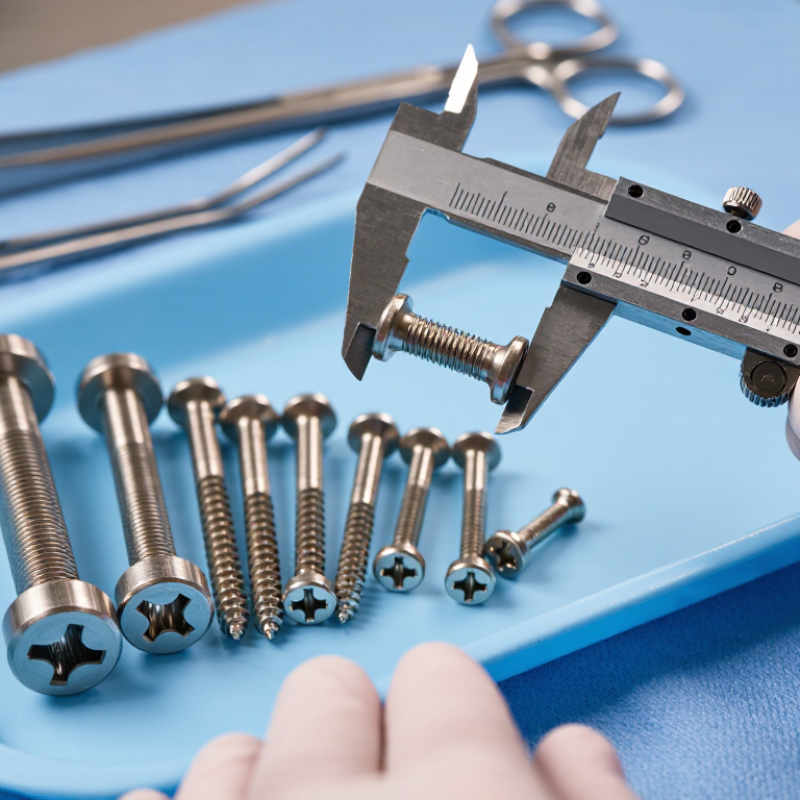
Compatibility requires more than matching diameter. Check thread profile, length options, driver interface, instrument fit, and imaging requirements. Verify that the screw works with the selected plate or fixation system. During sample review, measure critical dimensions with calibrated tools and record every result. Keep traceability from shipment to surgical use. No checklist is perfect. Procurement teams should revisit rejected samples, because small patterns may reveal larger process weaknesses. A polished surface may look reassuring, yet inconsistent documentation still deserves closer scrutiny.