What Is the Best Type of Titanium Implant?
Choosing the best type of titanium implant is rarely a simple shopping decision. The right option depends on anatomy, loading demands, surgical technique, and long-term maintenance. Titanium remains widely used because it combines strength, biocompatibility, and a strong clinical record. However, not every titanium implant performs identically.
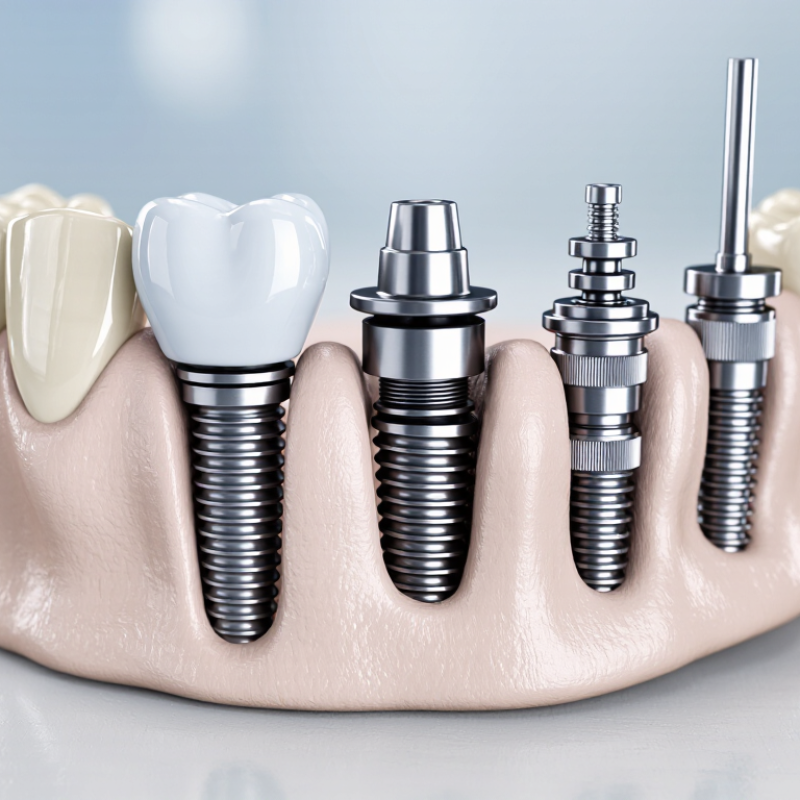
In dental care, commercially pure titanium, often Grade 4, is commonly selected for routine implant placement. Titanium alloys, such as Grade 5 titanium, may offer greater mechanical strength for demanding situations. Surface treatment also matters. A carefully engineered rough surface can support bone integration, while poor manufacturing control may create avoidable risks. Small design choices matter.
Thread shape, implant diameter, connection design, and surface cleanliness can influence stability. A narrow implant may suit limited bone width, but it may require careful force management. A wider implant can provide stronger support, yet it may not fit every anatomical site. Clinical experience shows that the “best” implant is often the one matched to the patient, not the most expensive brand.
Evidence should guide the decision. Look for peer-reviewed research, transparent manufacturing standards, and documented clinical follow-up. Regulatory approval is important, but it does not replace professional judgment. A qualified implant dentist or oral surgeon should assess scans, medical history, bite forces, and maintenance habits.
No single implant wins every case.
This article compares key titanium implant types, materials, surfaces, and designs. It also examines practical limitations that marketing claims may overlook. Some conclusions remain imperfect because studies differ in duration, patient selection, and surgical protocols. That uncertainty deserves honest attention.
Titanium Implant Basics: Grade 4, Grade 5, and ASTM F67/F136 Standards
When asking, “What is the best type of titanium implant?” the answer depends on anatomy, load, and implant design. Grade 4 titanium is commercially pure titanium. It is covered by ASTM F67 and offers strong corrosion resistance and biocompatibility. Many dental and orthopedic applications use it because its composition is relatively simple. Grade 4 is also the strongest commercially pure grade.
It is not automatically the best choice.
Grade 5 titanium, commonly specified under ASTM F136, is a titanium alloy with aluminum and vanadium. It provides higher strength than Grade 4, which can benefit small components or areas facing heavy mechanical loads. However, greater strength does not guarantee better clinical performance. Surface texture, manufacturing accuracy, sterilization, and bone contact also matter. A poorly designed implant can fail despite excellent material data.
Check the documentation carefully. The material certificate should identify the titanium grade, ASTM specification, heat treatment, and traceability. Experienced clinicians also examine implant geometry and the patient’s bone quality. Standards set important requirements, but they do not replace clinical judgment. In real cases, Grade 4 may be sufficient, while Grade 5 may offer a useful safety margin. Sometimes the published specification is incomplete, and that should raise questions. Titanium selection deserves evidence, not marketing language.
Comparing Strength: Ti-6Al-4V ELI Reaches Approximately 860 MPa
What Is the Best Type of Titanium Implant?
Comparing Strength: Ti-6Al-4V ELI Reaches Approximately 860 MPa
When engineers compare titanium implants, Ti-6Al-4V ELI often attracts attention. Its tensile strength can reach approximately 860 MPa, depending on processing and testing conditions. This value indicates strong resistance to stretching before failure. It does not guarantee better performance in every implant.
Strength matters. Fatigue resistance matters too. An implant may experience thousands of loading cycles during walking, lifting, or chewing. Ti-6Al-4V ELI contains tightly controlled interstitial elements, including oxygen, nitrogen, and hydrogen. This refined chemistry can support toughness and reduce sensitivity to certain forms of cracking. Material certificates and independent laboratory tests remain essential.
A stronger alloy can allow thinner sections, but geometry still controls real-world behavior. Sharp corners, poor surface finishing, or an unsuitable fit may create stress concentrations. I have seen material comparisons become too focused on one impressive number. That approach can overlook bone integration, elastic modulus, corrosion behavior, and surgical handling. The best choice depends on the implant site, expected loads, manufacturing route, and clinical evidence. Ti-6Al-4V ELI offers a compelling strength baseline, yet approximately 860 MPa is only one part of a responsible engineering decision.
Evaluating Biocompatibility: Surface Roughness and Osseointegration Evidence
What Is the Best Type of Titanium Implant?
Evaluating Biocompatibility: Surface Roughness and Osseointegration Evidence
Titanium is valued for its corrosion resistance and biological tolerance. Yet, the surface often matters more than the metal alone. ISO 10993-1 recommends biological evaluation based on an implant’s materials, contact area, and exposure time. Surface roughness is commonly measured by Sa or Ra values. Moderately rough surfaces, often around 1–2 μm, can support stronger early bone attachment than smoother surfaces. This range comes from widely used classifications by Wennerberg and Albrektsson.
The evidence is not perfectly tidy. Systematic reviews report that moderately rough implants generally improve early osseointegration. However, surface texture does not guarantee long-term success. A 10-year review reported implant survival near 95%, while outcomes still varied with smoking, bone quality, loading, and maintenance (Pjetursson et al., Clinical Oral Implants Research). Excessive roughness may also retain bacterial deposits. That risk deserves more attention. A 2023 review in Clinical Oral Implants Research found that surface modifications improved early bone response, but clinical advantages were not equally clear across every design.
Tips: Ask for documented Sa values, surface treatment details, and independent clinical evidence. Check whether the data involve humans or only laboratory models. A polished-looking report is not enough. My practical view is cautious: choose verified surface data, not roughness alone.
Reducing Stress Shielding: Titanium’s 110 GPa Modulus Versus Bone
What Is the Best Type of Titanium Implant?
Reducing Stress Shielding: Titanium’s 110 GPa Modulus Versus Bone
Titanium remains popular because it combines strength, corrosion resistance, and biological tolerance. Yet its stiffness creates a mechanical mismatch. The ASM Handbook reports an elastic modulus near 110 GPa for commercially pure titanium. Cortical bone usually ranges from 7 to 30 GPa, according to orthopedic biomechanics reviews indexed by the National Library of Medicine. Cancellous bone is far softer, often below 2 GPa. The gap is substantial.
A stiff implant can carry excessive load. Bone then receives less mechanical stimulation, especially near the implant surface. This process, called stress shielding, may contribute to bone resorption and weaker fixation. Clinical design reports increasingly examine porous titanium, lattice structures, and graded surfaces. These features reduce the implant’s effective stiffness without sacrificing every part of its load-bearing capacity. Small pore changes matter. Manufacturing accuracy matters more.
In practical evaluation, I would not judge titanium by modulus alone. A femoral stem needs strength at its neck, flexibility along its body, and reliable bone contact at the interface. ISO 5832-2 and ASTM F67 provide material requirements for commercially pure titanium, but they do not solve each patient’s biomechanics. That distinction is often missed. Porous titanium can lower stiffness, but it may also reduce fatigue resistance or complicate cleaning and inspection. The best implant is therefore a controlled compromise, supported by mechanical testing, imaging, and long-term clinical evidence. The answer is not perfectly simple.
What Is the Best Type of Titanium Implant? — Reducing Stress Shielding: Titanium’s 110 GPa Modulus Versus Bone
Typical room-temperature ranges; actual implant performance depends on geometry, processing, surface condition, loading, and patient factors.
| Material or Structure |
Approximate Elastic Modulus |
Relative Comparison with Cortical Bone |
Potential Stress-Shielding Effect |
Key Advantages |
Important Limitations |
| Cortical bone |
Approximately 7–30 GPa |
Reference material |
Not applicable |
Living, remodeling tissue capable of adapting to mechanical load |
Strongly anisotropic and variable with age, location, density, and loading direction |
| Commercially pure titanium |
Approximately 100–110 GPa |
About 3–15 times cortical bone, depending on the comparison |
Moderate to high in a solid, thick section |
Good corrosion resistance, biocompatibility, and established clinical use |
Higher modulus than bone may redirect load away from adjacent bone |
| Alpha–beta titanium alloy |
Approximately 105–115 GPa |
Typically several times higher than cortical bone |
Moderate to high when used as a dense, conventional implant |
High strength-to-weight ratio and strong fatigue performance |
Strength improvements do not necessarily reduce elastic mismatch |
| Metastable beta titanium alloy |
Approximately 40–80 GPa, depending on composition and heat treatment |
Closer to cortical bone than conventional titanium grades |
Potentially lower, especially in lower-modulus designs |
Can combine reduced stiffness with useful strength and corrosion resistance |
Lower modulus alone does not guarantee better fixation or long-term outcomes |
| Porous titanium structure |
Approximately 10–30 GPa effective modulus; design-dependent |
Can approach the range of cortical bone |
Potentially low when porosity, architecture, and implant geometry are optimized |
May support bone ingrowth and improve mechanical compatibility |
Reduced fatigue strength, manufacturing sensitivity, and possible pore blockage or debris concerns |
| Trabecular bone |
Approximately 0.05–2 GPa |
Much less stiff than solid titanium |
Reference material for low-density bone regions |
Highly porous, lightweight, and capable of remodeling |
Large variation in architecture and mechanical properties makes direct material matching difficult |
Interpretation:
A lower-modulus titanium alloy or a carefully designed porous titanium structure may reduce elastic mismatch more effectively than a conventional dense titanium implant. However, the “best” implant type must balance stiffness, strength, fatigue life, fixation, surface characteristics, manufacturability, and the patient’s bone quality. Elastic modulus is only one factor influencing stress shielding.